(The Discovery)
1774 The first vein of silver was
discovered by
Sebastián Coronado and Antonio Lamas
while they were exploring the sierra. (IPIÑA, p 14)
1777 On the 26th of August,
Sebastián Coronado registered the mine as “La
Descubridora”. (WALLACE, p 113).
1779 Coronado registered "La Descubridora" in Charcas on the 11th of
August. (MONTEJANO , p 16).
Berlandier, Vol.1, p. 216 puts the discovery date in 1773 and tells the story of how a cowboy
who had lost his horse was caught by a cold night and obliged to make
a fire. In the morning he was surprised to find melted silver,
which had run from his hearth. (This story is also told by
Ward, II, p. 506, who
mistakenly gives the date of the discovery as 1778.) The
vein was then worked by Sebastián Coronado who Berlandier describes as "a poor private
citizen who was not very rich and worked irregularly".
In a short time other mines in the Veta Grande, like Padre Flores and
Gaudalupe, as well as mines in the Veta Madre and Veta Refugio were in
operation.
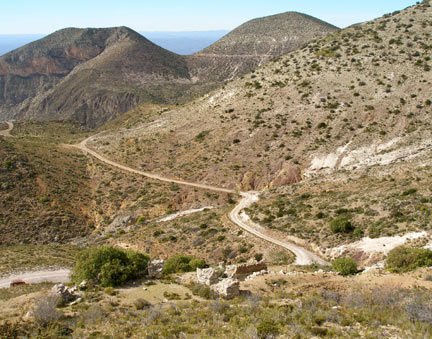
La Descubridora was located on the western flank of Cerro la
Descubridora, about 2 km. NW of the center of Real de Catorce at an
elevation of 2700 meters (See Map). Its ruins lie just above the road to La Bufa and Agua Blanca, 1.9
km. from the Panteon (cemetary) entrance. Little is left showing of
the operation except a few collapsed walls and at least four filled
entrances.
 |
 |
|
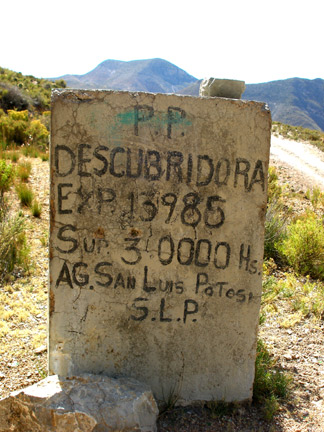
Looking toward the south over the Descubridora claim marker which
indicates a claim area of 30,000 hectares. Cerro Quemado is seen
in the distance. |
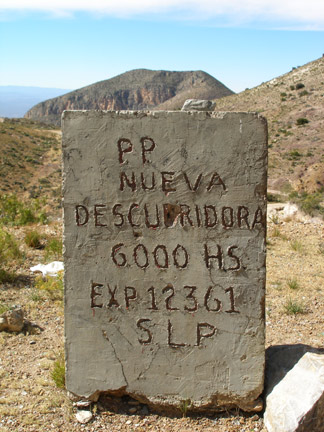
View to the west with La Bufa behind the nearby marker for
the Nueva Descubridora claim. Area 6000 hectares. |
|
Many claim markers similar to these are scattered over the
hills of the Sierra Catorce. Some, like these, are quite legible
and appear to be maintained. Others are in various states of
decay; some are only piles of loose rock. |
|
|
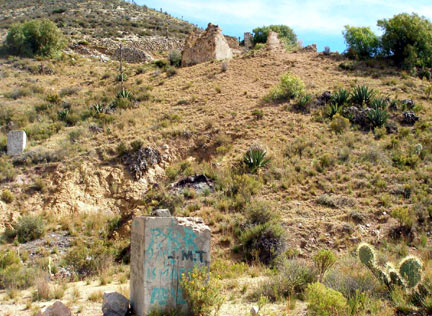
The mine ruins are spread over the side of the mountain above the claim markers. The cut in the hill behind the marker in the foreground was a lower entrance to the mine. |
 |
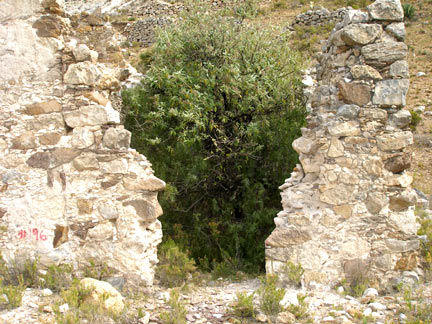 |
Inside the ruins there was a vertical shaft which would have
been used for access to lower levels. This hole is now
collasped and closed just a few feet down. A tree has grown
out of the rubble.
|
|
View to the west from above the La Descubridora Mine with La
Bufa in the background. The ruins in the lower part of the
picture are about all that is left of the original silver mine
operation.
|
 |
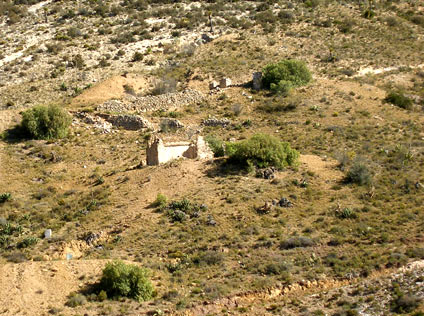 |
View of the mine from a hill to the west. The mine was
developed on at least three levels. The horizontal entrance is
at the bottom left, the ruins in the middle conceal the shaft
entrance, and more diggings are visible above the ruined
structures.
|